



Table of Content

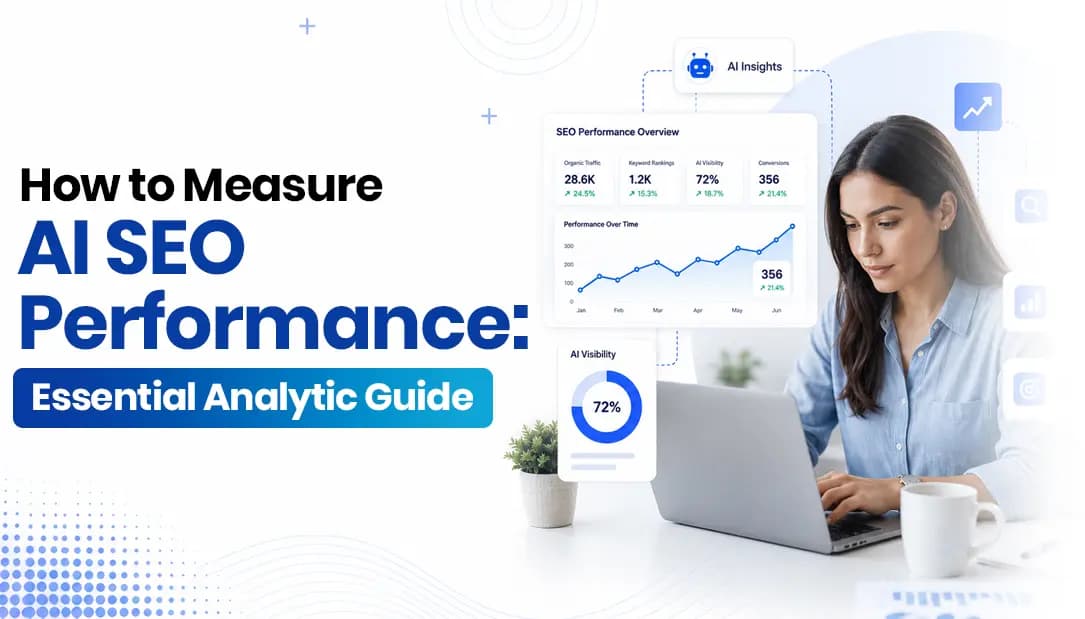
TL;DR: AI SEO measurement is no longer just about rankings. It is about your visibility, citation, and brand authority in AI responses by ChatGPT, Perplexity, Gemini, and Google AI Overview, as well as your ability to drive traffic and sales through this visibility. Focus on share of voice, citation share, AI Overview impressions and clicks, AI referral traffic in GA4, and conversions. You need a specialized AI visibility tracker tool (plus GA4), not mentions and vanity.
Key Takeaways
-
 AI SEO measurement means monitoring your visibility in AI responses, not blue link rankings.
 -
Among key metrics we can mention are share of voice, citation share, AI Overview clicks, AI referral traffic, conversions, and brand sentiment.
-
The traditional metrics are essential for building a base, but they are no longer sufficient.
-
A special visibility tracker for AI (along with GA4 and Search Console) is what you will use to track them.
-
Always tie AI visibility back to revenue, because a mention that drives no action is a vanity metric.
A mention in ChatGPT or a spot in a Google AI Overview feels great. But remember, a language model doesn’t sign up for your product. To see if your AI search strategy is effective, measure the right things. Track how often AI highlights your brand, how often it cites you, and if that leads to traffic and revenue.
This guide covers exactly which metrics to track, the tools to track them with, how to capture AI traffic in GA4, and how to report it all in terms your leadership cares about.
What Measuring AI SEO Actually Means in 2026
The term "AI SEO" is applied in two different ways, and it is the reason why most measurements fail:
-
Using AI to do SEO: AI tools that help with research, audits, and content.
-
Being visible in AI search: how your brand shows up inside AI answers and AI overviews.
This guide is about the second one, because that is where the new measurement challenge lives. Your customers increasingly start in a conversation with an AI, not a list of ten blue links. So the question is no longer just "Do I rank?" It is "Does the AI mention me, cite me, and send me qualified people?"
The Metrics That Matter for AI Search
Here are the key metrics to track, listed by importance, and what each reveals:
1. Share of voice in AI answers
How often your brand appears in AI responses for the prompts that matter to your business, compared with competitors. This is the closest replacement for old keyword rank tracking. Track it monthly as a trend.
2. Citation share
How often AI tools cite your site as a source. Rising citations signal that AI systems trust your content enough to attribute answers to you. Track the number of citations and which pages earn them.
3. AI Overview impressions and clicks
How often you appear in Google AI Overviews and how often people click through. Search Console now surfaces AI-related impressions, so watch impressions, clicks, and the gap between them.
4. AI referral traffic
Real visits arriving from AI tools like ChatGPT, Perplexity, Gemini, and Copilot. This is the proof that visibility is turning into people on your site. (How to capture it in GA4 is in the next section.)
5. Conversions and revenue from AI traffic
The metric that actually pays the bills. Tie AI referral sessions to sign-ups, leads, and sales. AI traffic is often smaller in volume but higher in intent, so watch conversion rate, not just sessions.
6. Brand sentiment in AI
How AI describes you, not just whether it mentions you. Run your brand through major models and note the positives, concerns, and misconceptions that recur.
7. Factual correctness
Whether AI states accurate facts about your products, pricing, and services. Repeated inaccuracies are a signal to strengthen the content and authority that AI pulls from.
How to Track AI Referral Traffic in GA4
AI tools pass referral traffic, so you can isolate it in GA4. Here is a simple setup:
-
In GA4, go to Reports, then Acquisition, then Traffic acquisition.
-
Add a filter for session source on AI domains. Such as including the following URLs: chatgpt.com, perplexity.ai, gemini.google.com, copilot.microsoft.com, and chat.openai.com.
-
Create a custom channel group or an Exploration that places those URLs into one channel named "AI Assistants," which then allows you to trend it.
-
Apply your conversions for that segment so that you can track sign-ups, leads, and revenue coming from AI traffic.
-
Save it as a report or dashboard so you can watch the trend monthly.
This turns a vague sense of "AI is sending traffic" into a number you can report and grow.

The Best AI SEO Performance Trackers and Tools
You cannot monitor AI visibility by hand. These are the categories and tools to know, grouped by what they do. Features and pricing change fast in this space, so verify current details before you commit.
Dedicated AI visibility trackers
-
Profound: enterprise-grade AI answer analytics, tracking share of voice and citations across major AI engines.
-
LLMrefs: prompt and visibility tracking with a free tier, close to old-style rank tracking for AI.
-
Ahrefs Brand Radar and AI Citations: tracks how often your brand appears and is cited across AI Overviews and assistants.
-
Peec AI and Otterly.ai: monitor brand mentions, citations, and sentiment in AI search.
All-in-one SEO suites with AI visibility
-
Semrush and similar suites now include AI visibility or AI toolkit features alongside traditional SEO.
Foundational analytics (you already have these)
-
Google Search Console: for AI Overview impressions and clicks.
-
GA4: for AI referral traffic, conversions, and revenue (setup above).
-
Looker Studio: to pull it all into one dashboard for clients or leadership.
The right stack is usually one dedicated AI visibility tracker plus GA4 and Search Console. Start there before adding more.
How to Prove AI SEO ROI to Leadership
Visibility means nothing to a CFO until it connects to revenue. To prove ROI:
-
Report AI referral conversions and revenue, not mentions. Lead with the money.
-
Show assisted conversions. AI often influences a journey that converts later through another channel, so use GA4 attribution to credit it.
-
Track branded search lift. When AI visibility rises, branded searches often rise too. Watch that correlation in Search Console.
-
Tie share of voice to pipeline over time, so leadership sees visibility and revenue moving together.
Do Traditional SEO Metrics Still Matter?
Yes. Rankings, organic traffic, and click-through rate are not dead, they are the foundation that AI visibility is built on. AI engines pull heavily from content that already ranks and earns trust. So keep tracking the basics, then layer the AI-specific metrics above on top. Think of it as expanding your scorecard, not replacing it.
A Simple AI SEO Measurement Framework
If you want a starting dashboard, track these monthly:
Layer | Metric | Source |
Visibility | Share of voice, citation share | AI visibility tracker |
Search | AI Overview impressions and clicks | Search Console |
Traffic | AI referral sessions | GA4 |
Outcome | Conversions and revenue from AI | GA4 |
Reputation | Brand sentiment and correctness | AI visibility tracker, manual checks |
Review it monthly, look for trends rather than daily noise, and always connect the top of the table to the bottom.
How Adaired Helps
Measuring AI search is new for most teams, and the tooling is still settling. Adaired Digital Media brings 9 years of experience in SEO and content, and we now help businesses measure and grow their visibility across AI search, from setup and tracking to the content that earns citations. If you want the tactics behind getting featured, start with our guide on how to optimize content for Google AI Overviews, and if you are weighing whether to build this in-house or outsource it, see our in-house vs outsourcing SEO guide. Ready to measure what matters? Book a call.
Frequently Asked Questions
How do I measure AI SEO performance beyond rankings?
Track share of voice in AI answers, citation share, AI Overview clicks, AI referral traffic in GA4, and the conversions that traffic drives. Rankings become one input among several.
What metrics measure success in AI search engines?
The core set is share of voice, citation share, AI overview impressions and clicks, AI referral traffic, conversions, and brand sentiment. Lead with the metrics tied to revenue.
How do I track AI referral traffic in GA4?
Filter or segment session sources for AI domains like chatgpt.com, perplexity.ai, and gemini.google.com; group them into a custom channel; and apply your conversions to measure outcomes.
What is the best AI SEO performance tracker?
There isn't one best AI SEO tracking tool. It depends on what you want to measure. Tools like Profound, LLMrefs, Ahrefs Brand Radar, Peec AI, and Otterly help track the visibility in AI search. Google Analytics 4 (GA4) and Google Search Console help you track website traffic, clicks, and SEO performance.
How can I prove ROI from AI search optimization?
Report AI referral conversions and revenue. Include assisted conversions. Track branded search lift and share of voice. This way, leadership can see visibility and revenue increasing together.
Do traditional SEO metrics still matter for AI optimization?
Yes. Rankings, traffic, and CTR remain the foundation AI visibility is built on. Keep them, and add AI-specific metrics on top rather than replacing them.

Dheeraj Swami
Founder & Digital Growth Strategist at Adaired
As the founder of Adaired, he has successfully worked with brands across various industries, helping them improve online visibility, generate qualified leads, and drive measurable business results.
Latest Articles
Reverse Engineer Anything With REA MCP on GitHub:
Oct 19, 2026
.webp&w=3840&q=75)
The Future of IT Staff Augmentation in the US Tech
Oct 16, 2026

How to Create a Content Strategy That Drives Traff
Aug 31, 2026
Why Did My Website Traffic Suddenly Drop? Causes,
Aug 19, 2026
%20Guide%202026%20Rank%2C%20Get%20Cited%20%26%20Drive%20AI%20Search%20Traffic.webp&w=3840&q=75)
Answer Engine Optimization (AEO) Guide 2026: Rank,
Aug 14, 2026
Categories
Trusted By 1000+ Clients
We Don't Just
Market Brands
We Build Them
We help businesses build clear and reliable brands that attract customers and support long-term growth.